Showing posts with label Barbados. Show all posts

Friday, April 30, 2010

April 28, 2010 - Barbados

We've really enjoyed some aspects of being anchored in Carlisle Bay. The water is so clear and warm that we swim every day. So do the locals. Every morning we wake to the sound of Bajans coming down to the beach for a swim before work. The jockeys from the local track bring the horses down for a sea bath at dawn as well. All of this would be more charming if the nightclubs that line the beach hadn't been going until 4:00 am. But even so, this is an uncommonly nice white sand beach.

Unfortunately, it is not such a great anchorage for a monohull. We spend all day and night rolling in the swell. If we had come to Barbados from a flat anchorage, we wouldn't have stayed more than a day or two with these conditions. But since we've either been underway or anchored in open roadsteads for the past two months, we're quite acclimated to the motion. But when the swell built to the point where the waves crashing into the beach became surfable, it was time to go.

If the swell hadn't gotten to us, the dismal selection of staples and produce at the central grocery store in Bridgetown would have forced us to move on. Our provisions are running low and Barbados is an obscenely expensive place to restock. As one expat told us, by way of explanation, "It's Barbados, Old Boy!"

Since the fishing was so unproductive during the two months it took us to travel up from South Africa, we've decimated our frozen meat supplies. With no chicken and only two steaks left, we turned to harvesting the local fruits of the sea. We're pretty sure it is legal to take conch here, but just in case, we're not posting any incriminating photos.

With visions of deli cases filled with pate and French cheese, we are headed to Martinique. The 112 mile trip is too long to do in a day, so we'll overnight it.

----------
radio email processed by SailMail
for information see: http://www.sailmail.com

Monday, April 26, 2010

April 25, 2010 - Scenic Tour, Barbados

Every Sunday the Barbados Transportation Board runs a scenic bus tour around the island. Since we are cheap, we decided to hop on the bus for a day rather than rent a car or hire a taxi driver.

We knew we'd made the right choice when we tied the dinghy up in the Careenage and noticed the sno cone cart parked next to the bus. Any adventure that begins with a sno cone has to be good.

We bought some cones and grabbed some seats. Next thing we knew a whole Bajan family was filling in the seats around us. They had with them a picnic basket, bag of ice and a bottle in a brown paper bag. Then they leaned out the window and ordered a round of sno cones. As soon as their cones had enough room, they topped them up from their bottle of rum punch. We felt decidedly unprepared with our measly two sno cones and bottles of water.

The bus wound out through the narrow old streets of Bridgetown and up into the interior of the island. We passed lots of sugarcane fields and horse farms. Polo is a very popular sport on the island and a match was just getting underway at the field across from the farm where these guys were grazing under the palms.

We crossed the island on some back roads, which didn't seem nearly wide enough for both the bus and the cars parked along the edges, as the bridge on the main highway had been washed out. Our route took us through some lush gullies filled with tropical foliage, but most of the scenery was agrarian. And then we found ourselves on the east coast at Bathsheba, home of the island's most famous surf spot, Soup Bowl. With light swell and a strong onshore breeze, the break wasn't working, but the scenery was fabulous.

From Bathsheba we made our way south past a pair of botanical gardens and back inland to St. John's Church. The rustic coral stone church that stands at the site now is not the first to grace the property. The first, erected in 1645, was destroyed by fire. The second, rededicated in 1676, was destroyed by hurricane. During the 19th century the parish's luck seems to have changed for the better. The current structure has been standing since the 1830's.

The tombs in the burial yard overlooking the sea are shaded by flowering trees. It really would be a lovely spot to spend eternity.

From St. John's the driver took us south to Silver Sands, a beach on the Southeast corner of the island. We wandered down to the resort perched at the edge of the rocks and sidled up to the bar for some refreshments. Then we rejoined the bus for the trip back to Bridgetown. It was a long day, but a low-key way to see parts of the island that we would not otherwise.

Saturday, April 24, 2010

April 23, 2010 - Carlisle Bay Marine Park, Barbados

Just a short dinghy ride away from our anchorage is the Carlisle Bay Marine Park. In this spot in 1919 the Berwyn, a French tug boat, was sunk by her own crew. Since then a handful of boats have been intentionally sunk in the park, including one that was seized for smuggling marijuana, and a few wrecks have been relocated to the park from other parts of the island. Old canons and anchors lying on the bottom point the way from wreck to wreck, making it easy to locate all the wrecks.


The older wrecks have a a lot of soft coral growth and large populations of very friendly reef fish. They must be fed by the local dive and day boat tour operators.


We waited until all the day boats had finished their daily runs, then went over for a late afternoon snorkel. Under us were three divers checking out the wrecks from a slightly different vantage point. Their air bubbles made the wrecks look like they were breathing, which was a little spooky at first.

Snorkeling the wrecks, happy hour at the yacht club, and learning that our friends Kate and Deb had booked their flights to come visit us in St. Maarten next month were the highlights of another great day in Barbados.

Friday, April 23, 2010

April 22, 2010 - Carlisle Bay, Barbados

Barbados is expensive. Seriously. I don't remember the Caribbean being this pricey. It will be interesting to see as we head north if Barbados is more expensive than the other islands or if we've just gotten really cheap over the past three years.

We're really struggling with how much everything costs here. So when a Dutch guy swam by our boat on Wednesday and suggested that we join the yacht club because it had good cheap food we were definitely interested in checking it out.

Yesterday we stopped in around lunchtime and became temporary members of the Barbados Yacht Club. Standing there in our flipflops and shorts we were a little intimidated by the business lunches taking place in the formal dining room over roast beef and yorkshire pudding, so we headed out to the much more casual grill down by the beach. The Dutch guy had not steered us wrong. The menu prices were 30% of those in town and the food was really good. The difference is enough that when our free membership runs out in a week we may be tempted to become paying members.

And as an added bonus, we were also given the password to the yacht club's wifi service, which we can pick up out in the anchorage. I think the last time we had access to free, unlimited wifi was 2 years ago in New Zealand. I've taken advantage of the club's wifi to upload the photos from our run from Ascension. Scroll down to see them.

After lunch we moseyed up the hill to Barbados Museum to get some culture. The displays were mildly interesting but the old brick garrison buildings that housed the galleries and the surrounding grounds were gorgeous. There were cascading purple blooms everywhere.

Today we aimed a little lower on the culture scale and hopped on a bus up to the Mount Gay Rum Visitor Center to learn more about how rum is produced. Our tour guide was very entertaining as she tottered around on 4 inch spiked heels and talked about the role of the rum shop in Barbados society. After a short film about Mount Gay's history, she led us into the bottling building. The factory produces 10,000 bottles a day, 85% of which are exported.

Interestingly, the rum available on the island is 43% alcohol. But the exported bottles are all 40%. As the bartender leading the tasting at the conclusion of the tour explained, "That is why we are happy and you are miserable."

One thing that is not expensive in Barbados is rum. So we bought enough rum to fill a storage compartment and headed out to catch a bus back to the Carreenage where we had left our dinghy. After an hour of waiting, in a continuously shrinking patch of shade, we finally gave up and started hoofing it back, each of us loaded down with several bottles of rum. Within minutes, a bus sped by us. Isn't that always the way?

By the time we had walked the few kilometers back to town, we were both hot and sweaty. We slid into a booth in an airconditioned food court and panted for a few minutes. Then we split a few guava juices and bottles of water to cool down and rehydrate while sharing a chicken roti for lunch/dinner.

Back at the boat I put on a suit and jumped in the water to cool down. While I was floating around Sten struck up a conversation with the three naked Swedes on the tiny (20ft) boat next to us. We wound up having them over for a few rums. We were shocked to learn that the three of them had sailed to the Caribbean from Sweden on that tiny little boat. Even more impressive, they handsteered all the way. After the adventure they've had these past few months, university is going to be a cakewalk.

Okay, so how many of you assumed that the three naked Swedes were female? Guys, sorry to disappoint you. Ladies, they were pretty good looking, even if they were just this side of jailbait.

April 20, 2010 - Carlisle Bay, Barbados

Barbados is just beautiful. We are anchored in 14 feet of clear aqua water over white sand off of a long beach lined with bars. It is so nice to be at anchor. There is a little roll, but it is nothing compared to St. Helena and Ascension. We tried 5 times to anchor further out, but the CQR just dragged across the bottom. Finally we gave up and moved in to the front of the moored boats. It makes us a little nervous to be so close to the shore, but there is less current in here so it is more comfortable.

There are lots of juvenile turtles around. Our anchor disturbs the sea grass and so they treat it like a buffet line. The other day there were 10 snacking along our chain. And they don't seemed to be bothered when it swings over them.

Our first full day here was a Sunday. We spent the morning walking around Bridgetown, the capital of the island, admiring the mix of grand Georgian and chattel house architecture, while we looked in vain for a place to get Sten's hair cut. Most of the shops and business were closed so we headed back to the boat to do some much needed hull cleaning. We were in the water for hours without getting cold. That evening, the opening act of a week-long series of reggae concerts kicked off on the beach in front of us. There was a huge crowd that even the rain couldn't disperse.

Monday found us back in Bridgetown for lunch at a spot that advertised complementary wifi. After a few weeks without internet it is always a relief to check all the accounts and credit cards to make sure that everything is roughly as we expect it to be. Sten found a barber who was able to tame his mop and who also, since he had him in the chair, tried some creative up-sells. After Sten turned down the pirated DVD's, the barber flipped open his phone to a picture of two girls kissing and offered to hook Sten up with them. You've got to admire a guy with entrepreneurial spirit.

Tuesday morning we swam into the beach wearing our hats and shades and reefshirts (we're so not cool) with the intent of walking it. We didn't get very far before we started talking to a Bajan couple who had flown in from England for their daughter's wedding. Unfortunately, they were the only ones here. The rest of the party has been delayed by the volcanic ash grounding European flights.

Next, we met a New Yorker who spends four months a year at his house here. We wound up talking to him for quite a while. But we were so busy answering his questions about piracy and firearms that we completely blew the opportunity to quiz him about his favorite restaurants and the best grocery stores. By the time we wrapped up our conversation, we were well toasted and had to swim back to the boat to find some shade.

We spent the rest of the day swimming and cooking. Sten made BBQ sauce for the chicken we would have for dinner and I made flan. When the galley got too hot we just jumped in to cool off. It is good to be back in the Caribe.

Sunday, April 18, 2010

April 17, 2010 - Caribbean Landfall

Land Ho!

It has been exactly two months since we departed South Africa. In that short period we've sailed at least 5500 miles (I don't know the exact number; the trip counter on the chart plotter maxes out every 9999 miles, which it did at some point during this passage, and stops counting until one of us manually resets it, which I did when I noticed it, but it could have been on the blink for days). That's a lot of miles in two months. That's almost as many miles as we covered during the seven months it took us to travel from New Zealand to Singapore (via Vanuatu, Australia and Indonesia). It feels like all we do is sail. At one point last week we were tempted to hang a right and keep going all the way to Bermuda or home to Newport - you know, since we're in the groove. That bout of momentary insanity lasted all of two minutes.

During the last four days of the run from Ascension we had a variety of mostly pleasant sailing conditions. For two days we ran downwind under sunny skies with a full main and the jib poled out to windward. Then we sailed right into the middle of a high pressure system that killed the normally reliable northeast trades. So then we spent a day and a half motoring. Unfortunately, most of the time we were running the engine we were pushing a frustratingly persistent counter current, which ran up to 2 knots at times. If we hadn't been motoring, we would have been drifting back towards Brazil. This morning as we closed Barbados we finally shook the current and the wind filled in. We sailed the last few miles in light air cutting through flat seas in the company of whales.

18 days after departing Ascension, we arrived in Carlisle Bay, Barbados this afternoon. The 3000 mile passage from Ascension took us one day less than our 3000 mile Pacific crossing three years ago. That passage remains our longest uninterrupted stretch of time at sea.

For all the good they did us, we might as well have left the lines stored on the outboard handle.

Unlike our Pacific crossing, fishing has been abysmal on this passage with only one small wahoo landed and a small tuna lost at the boat to show for something like 7000 lure miles (we trailed an average of 2.5 lures for 3000 miles). From talking to friends who sailed from South Africa to Brasil, it seems that our experience is not atypical for the South and Equatorial Atlantic. So, we've been hitting the freezer pretty hard. There is nothing like chateaubriand on the grill to break up the monotony of a long passage. Our somewhat sparse (okay, really sparse) South Africa provisioning also provided us with an opportunity to determine that given enough time crackers purchased in Malaysia and India will still go off, no matter how much palm oil they have in them.

Sten has been doing yoeman's work in the galley on this trip. Last week when we were uncomfortably pounding along, beam to the seas, he spent two hours making a hearty sausage and tomato pasta sauce from scratch on a boat that was hurking and jerking. For two weeks, until the big stalk bananas that St. Ledger gave us at Ascension finally ran out, he made banana walnut pancakes for us most mornings. His pancakes are delicious, nutritious and parsimonious - they use 2 fewer eggs than fried eggs or an omelet. Yesterday he took advantage of the fact that we were motoring along in flat calm seas to make waffles, which are always a treat.

When we arrived in Carlisle Bay this afternoon Sten called the Bridgetown Signal Station on 16 and asked if we could anchor and proceed to do our clearance by dinghy. He explained that we were hesitant to bring our yacht into the commercial port with a stiff northwesterly (not the typical northeasterly) blowing. The radio operator said that was unusual and that he would have to ask Customs. He called us back after a few minutes and confirmed that we could come to the port on our dinghy. It is kind of a long dinghy ride from the bay (particularly with a NW wind blowing) but once we were in the port we were glad we had done it. There are big square fender pads every 25 feet or so to keep cruise ships off the cement wall. There is one section of wall without standoffs in a corner near the tug boat where we could have tied up but the substantial chop and wind blowing against the wall would have made things decidedly interesting.

While I was in the the cruise ship passenger terminal visiting the Port Health, Customs and Immigration offices (in that order), Sten was out floating around the harbor in the dinghy as there wasn't a decent place to tie it up (the pilot boat was parked in front of the closest steps). By the time I got back to him, he had been baking in the sun for an hour and all he wanted was to find a spot to have a cold beer. So we took the dinghy up the Careenage, a canal leading into the center of Bridgetown. We found a waterfront cafe and parked ourselves at an outside table. Sten ordered a Banks, the local beer and I had a rum and tonic, which is not a hardship when the local is Mount Gay.

As we sipped our drinks we watched sportfishing boats offload their catch and a guy sitting in the stern of one boat painstakingly filleting one flying fish after another. Flying fish is a local favorite, so we ordered some for dinner. For a fish that smells so strong when it lands in our cockpit or on deck underway, the flesh is surprisingly mild. After the fried stuff I was ready to order dessert, but Sten wanted to have some more "real food" first, so we ordered a round of fish cakes. The texture reminded us of Rhode Island clam cakes, but the flavor was much saltier as they are made with rehydrated salt cod. During the time of slavery and sugar plantations, salt cod was a cheap way for plantation owners to provide their workers with protein and to replenish the salt they lost sweating in the fields. Today it remains a common ingredient in the traditional cuisine of Barbados.

Tuesday, April 13, 2010

April 13, 2010 - 9 Degrees North

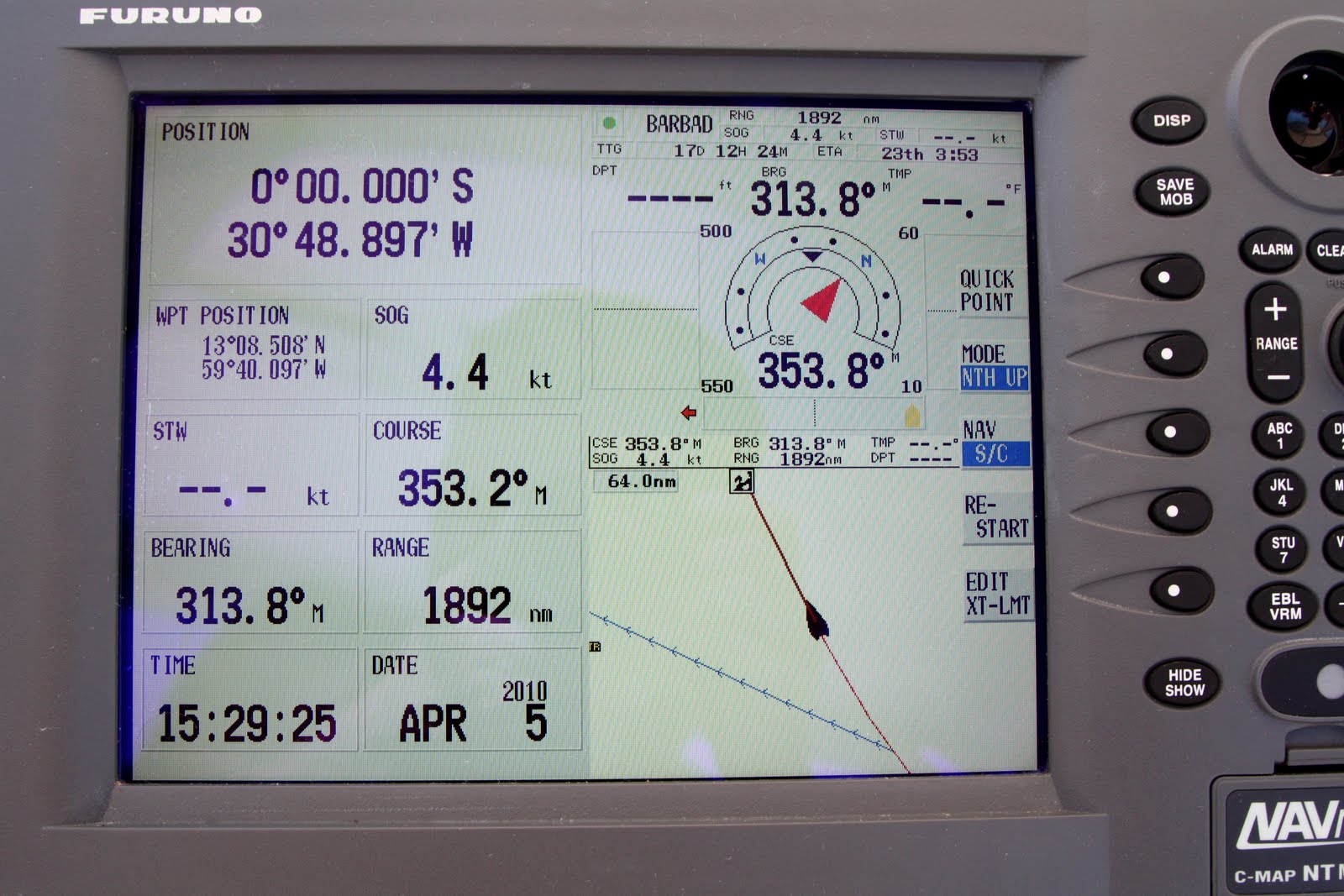
When I last wrote we were two degrees south of the Equator. We had lost the wind and begun motoring. For two relaxing days the engine purred away as we drove north looking for the wind.

The first order of business was to fix the jib sheets. So Sten strapped on the bosun's chair and I hauled him up the forestay so he could reattach the now slightly shorter jib sheet. We figured this would be easier than dropping the jib at sea and it worked out well. The next day he changed out the primary Racor filter on the engine and I did some laundry as it was perfect drying weather. It was terribly hot so I took advantage of all the extra power coming off the engine to plug in the blender and make us some smoothies. While trying to make a blended version of teh tarik, I discovered that condensed milk, ice and chai tea makes an excellent beverage. The condensed milk makes for a thicker, creamier frappe than regular milk.

We celebrated our fourth and final Equator crossing of this trip with a swim, a bottle of bubbles and a BBQ. It is usually too windy and rough to grill underway, but since we were motoring along in 3 knots of breeze and a minimal swell it was very manageable.

After 40 hrs of motoring and a few hours after we crossed the equator (at 30.49 West) the wind filled in from the northeast. We didn't believe that we were through the ITCZ yet, so we sailed hard on the wind, pounding north. We planned to keep beating up to 4 North to make certain that we were through the ITCZ before we cracked off onto the rhumb line for Barbados.

At 2 North we pulled down some fresh weather reports and found that the wind was forecast to disappear on us again as we approached Barbados. We realized that adding extra miles onto the trip by continuing north to make sure that we were clear of the ITCZ would add too much time to the trip as we risked losing the wind before we were within reasonable motoring range of Barbados. So at 2 North and 32 West we cracked off the wind and headed straight towards Barbados on a beam reach.

For the next six days we had overcast skies and squally conditions. Even once we were certain we were beyond the reach of the ITCZ the unsettled weather continued. Our days were punctuated by big wind and temperature shifts, coupled with heavy rain, all followed by long lulls that left us wallowing uncomfortably in the swells. And then the wind would fill back in and we'd be bashing along again.

As it turns out, beam reaching in choppy seas is an awfully uncomfortable point of sail. Unlike downwind sailing, where the boat does a gentle roll as waves slide under her stern, when we are taking the seas right on our beam there is no rhythm to the movement of the boat. With the wind and seas on our beam the whole boat rocks from side to side, but the motion is choppy and jerky. It makes doing anything (walking, sleeping, cooking, washing up, writing) difficult. I seem to stub a little toe every time I stand up. We've spent a lot of time this past week laying down and reading. We can feel our legs atrophying. Luckily, Barbados is a relatively flat island.

Beam reaching might not be comfortable, but it is fast. We've been reeling off a steady 170 to 180 miles a day.

Between the squalls and the spray we had to keep the hatches and side ports closed to keep the boat dry down below. Two nights ago we had big wave catch us broadside, filling the floor of the cockpit (for only the third time in three years) with a few inches of water and sending a hail of saltwater down below.

We have been grateful for the cloudy weather, otherwise we would have been steaming away with the boat all closed up. As the sun comes up this morning it looks like we are actually going to have a sunny day today. And with the wind backing, we'll be setting out the pole this morning so that we can start running wing-on-wing again. We have about four more days (and nights) to go before we reach Barbados.

Sunday, April 04, 2010

April 4, 2010 - 2 Degrees South

So much for our hopes of having 4 or 5 more days of the good stuff before reaching the ITCZ. Last night we were hit with a series of line squalls. After 5 blissful nights where our biggest concern was keeping the sooty terns from using our bimini as a latrine, everything changed.

If we'd known that this was going to be our only catch of the passage we would have savored every bite.

The first line of squalls hit us just at sunset and just as Sten was about to serve dinner (rice and wahoo in a garlicky, capery tomato sauce). Buckets of rain came down and the wind shifted 20 degrees, but the windspeed didn't increase that much. When it was over, the wind died. We picked small bones out of the fish in the dark as we flopped around waiting for the wind to fill back in. We split an apple for dessert and then Sten went to bed.

For the next few hours we had intermittent showers, but no real shifts in wind direction or velocity. The only thing that I found troubling was seeing lightening around us for the first time this passage. Around 0200 I came off watch, and Sten came up. About an hour and a half later, we were hit with an intense squall, accompanied by torrential rain, wind building to 25 knots and a 90 degree wind shift. The boat jibed while Sten was below closing the hatch above my sleeping head. The preventer on the mainsail did its job, but the increased pressure on the backwinded jib caused a jib sheet, which had been slowly (we thought) chafing on the pole for the past 5 days, to part. Sten brought the boat around to get the main back on the proper side, but the jib was flapping around, out of control. I'd managed to sleep through all of this, so he had to come down to wake me up before going on the foredeck to wrestle with the jib. After some work, we got the jib furled and the shredded sheet, which had been trailing behind the boat, back on board. Now we could see about getting ourselves back on course.

In the dark of night, with the moon and stars completely obscured by cloud, far from land, it can be hard to get one's bearings. It took us a few minutes of looking at the compass, the chart plotter, the radar screen and finally the radar overlay of the charts to get ourselves re-orientated and figure out what the weather system was doing and which way we could go to get clear.

We had been running dead downwind for days, oscillating between a compass heading of WNW and NW. We were still running downwind (the new downwind) with the main prevented out, but now we were heading due south, traveling with the squall. Running with a squall is a slow and ineffective way to shake it. We decided to turn upwind into the weather in attempt to get clear of the squall and (as an added bonus) to head towards Barbados instead of away from it. Sten went forward to take off the preventer and then came back to the cockpit to start cranking in the mainsheet for a tack. I started to turn the boat into the wind, but just in the nick of time Sten realized that the running backstay was still on. He eased it and we completed the tack, driving ourselves right into a fresh band of rain. I was still at the wheel, so I kept steering hard on the wind. There was so much rain and wind that I had to cock my baseball hat down at an angle over one eye to keep my contacts from flushing out of my eyes.

Eventually, we drove through that band of rain and into a lull. However, the radar showed several more lines of rain around us. It was going to be a long night, but with just the mainsail up, the boat is easily manageable by one of us. At 0430 I went back to bed. By 0800 we passed through the last of the lines of rain. Unfortunately, we had also sailed out of the wind. So Sten reefed down and centerlined the mainsail (our preferred motorsailing setup). He turned on the engine and pointed us NNW. I woke up to the sound of him reefing, but after my interrupted off watch, it didn't take long for the engine to lull me back to sleep.

It was several (okay, many) more hours before I roused myself out of bed. Sten passed me a cup of reheated coffee and a freshly toasted bagel with cream cheese, and we tried to figure out whether we were in the ITCZ already. The dramatic changes in wind velocity and direction suggest that we are. But we are approximately six degrees south of where the ITCZ is supposed to be, according the daily reports we've been downloading. Unfortunately for us, we could have 3 more days of this nonsense before we break into the Northeasterlies on the other side of equator and the far side of the ITCZ. But we've got plenty of diesel to keep us moving and a fridge full of cold drinks to keep us cool.

Friday, April 02, 2010

April 2, 2010 - East of Brazil

Sunrise in the South Atlantic

For the past four days we've had near perfect sailing conditions - sunny days, starry nights, consistent breeze, a favorable current, and comfortable seas. Mata'irea is romping along wing-on-wing under a full mainsail and poled-out jib, chewing up the miles between the South Atlantic and the Caribbean with very little assistance from us. We're hoping to have 4 or 5 more days like this before we enter the dreaded ITCZ.

The Intertropical Convergence Zone or ITCZ is an area near the equator where the southeasterly breezes that are predominant in the Southern Hemisphere collide with the Northern Hemisphere's northeasterlies. When the two wind patterns collide, they produce an area of unstable weather, characterized by violent squalls, followed by periods of calm.

ITCZ is a relatively modern term for an ancient phenomenon. Seamen used to refer to this region of unstable weather and light winds as the doldrums. Before ships had engines they could be trapped in the doldrums for days or weeks, waiting for a breath of wind to fill their sails. Luckily, we have an engine, and plenty of diesel to power through the calms if need be.

The ITCZ moves around constantly. The yachts that left St. Helena a few days before we arrived had the bad luck to have it pass back and forth over them several times as they made their way north. We've been tracking the movements of the ITCZ via daily Met.5 forecasts that we download through Sailmail. It is currently 3/4 of a degree wide (about 45 miles) and has been hovering between 2 and 4 degrees north of the equator. We're hoping that it says put for the next week. It will be a few more days before we cross the equator and then we should have another day or two of smooth sailing before we have to start working for our miles in the ITCZ. Once we pass through it, we'll be squarely in the northeasterlies, making fast miles for Barbados.