
For the past few weeks, really, ever since we returned to the Caribbean, I've been banging out mundane blog posts about anchorages and sailing and cocktails. I wrote the post about completing our circumnavigation several times, but scrapped every draft that dealt with anything other than the barest facts. I even roped my friend Deb into writing a few posts for me. All because I didn't want to address the issues surrounding the end of our adventure. The fact is that I'm scared and I didn't want to talk about it.
All the time people ask us what the scariest moment of the trip has been. It is the number one question we get (followed closely by "do you carry guns" and "what about pirates? - I'm sensing a theme here). I always found people's fear-based reactions to our adventure interesting, but I couldn't relate. Now, now I get it.
I'm filled with anxiety about the end of our adventure. I'm more scared of going home and trying to resume some semblance of a normal life than I have ever been about any leg of this trip.
Even before we left Boston four years ago I was concerned about how we would deal with our re-entry to the civilized world. I expected (no, hoped) that sailing around the world would change us, but I was apprehensive about how those changes would effect us when we tried to fit back in with a land-based lifestyle. Would we be square pegs trying to wedge ourselves into round holes?
Before we set off I posted a message on a cruising bulletin board soliciting others' experiences with moving back ashore. Back then my questions focused on how our potential future employers would view us. Would we become damaged goods by taking ourselves out of the job market for almost four years? These days whether anyone wants to hire us or not is the least of my concerns.
I'm afraid of not being able to relate to our old friends. It has been 18 months since we've seen any of our friends from home (other than those who came out to visit us in South Africa and the Caribbean). How much will they have changed? How much will we?
I'm afraid that desk jobs will bore us senseless.
I'm afraid of letting the internet suck up days, weeks, months of my life. I used to self-medicate at work with regular visits to celebrity gossip sites. I was reading Perez Hilton long before he became a household name. Seriously, what a waste of time. Sten's little vice was the New York Times. Any time either of us needed to destress or escape, we'd immerse ourselves in news about Things That Don't Matter. Getting all caught up with dramas on the other side of the world or that impact people we don't know and are not likely to meet was how we avoided dealing with the stuff that does matter.
On this trip I have learned to entertain myself in ways that benefit me and those around me. I can now name just about any reef fish you put in front of me, bake a mean batard, boule or baguette, and whip up any number of cocktails. But any time we have access to the internet for more than an hour at a time I find myself sliding into old habits. I need to find something to do with myself that does not require me to sit in front of a computer all day.
I'm afraid of becoming less frugal and more influenced by consumer culture. During the years leading up to our departure we learned to live relatively frugally. It is what made this trip possible.
When people ask us how we could afford to quit our jobs and travel I usually joke, "well, our other option was buying a plasma." We had one car, which Sten inherited. Our housing payments cost us way less than what we could afford (at least according the mortgage industry). I kicked a $9 a day Starbucks habit. For two years (from the moment we decided to sail around the world until we left) we only bought clothing if we absolutely needed it (like when Sten's cuffs and collars frayed or my pants wore out at that pesky spot between the thighs). Any time we wanted to buy something the analysis was "will this get us to the Tuamotus?" If it didn't, it went back on the shelf.
Our frugality only intensified after we left. At the beginning of our trip we managed to put ourselves in dire financial straits. We had been relying on the sale of our house to pay off our boat loan and fill our cruising kitty. However, our house had been on the market for several months and we hadn't had an offer. There were only a couple thousand dollars in our bank account. But it was early November and we had to leave Newport then or wait until the Spring. So we left, trusting that our house would sell in the new year.
Then, two days before we left Newport for Bermuda we did something very stupid. Through the wonders of electronic banking, we mistakenly double paid a very large credit card bill (containing some major expenditures from our Newport refit). We went from black to red with one click of the "enter" key. You would think it would be easy to unwind such a mistake, but apparently any bank transaction over $10,000 triggers the Patriot Act. And so it was weeks, and many expensive phone calls from Bermuda and St. Martin, before the credit card company returned the money to our bank account. In the meantime, Suzy stepped in and floated us, for which we still are very grateful. But we didn't want to be too much of a burden and so we learned to live on just a few dollars a day. Those lessons in frugality have served us well. Even after the house sold and we were once again on sound financial footing, we were still very careful about what we spent money on.
These days we'll splurge on things that matter to us - our health, communicating with friends and family, keeping the boat seaworthy and comfortable, travel, and good food and drink. But we'll always take public transportation if it is an option. We'll negotiate for anything. We never accept the first price offered. If a place has a low-cost of living, that makes it attractive to us. And so when we are asked what our favorite destinations were, we find ourselves saying things like "Indonesia - you could live really well for very little." Which we realize is not what most people look for in a vacation destination. Which only reinforces how out of sync we've become with society's values.
I'm afraid that we will lose our grasp on the frugality that set us free from the mundane and has allowed us to continue to live a different life. If we don't have another adventure to save up for, if we don't have a need to live cheaply, will we be susceptible to media and community messages that we need to buy this, that and the other thing? I know that material stuff won't make us nearly as happy as snorkeling over a pristine reef or catching a bull mahi on the fly, but we both have our weaknesses. But I'll say this now: the day we buy a wii is the day we have to head back to sea.
I'm afraid of becoming trapped by possessions. Being debt-free is so liberating. I don't want the burden of having to service a mortgage or a car loan. But how does one function on land without shelter and transportation? Maybe the answer is to only take jobs that one can reach by dinghy.
I'm afraid of losing my new found sense of self-esteem. I think I'm gorgeous (I didn't always). So does my husband. Why should I care what anyone else thinks? Why should I hold myself up against the images in magazines and on television? I know I shouldn't. But I do. Oh, I do.
Just a week with the magazines that Kate and Deb brought us on their recent visit has had a negative impact on my body image. All those lovely curves and that positive buoyancy are apparently "muffin tops," "bat wings," and "squidgy bits" that must be banished through a rigorous regime of 250 calorie meals and daily 60 minute work-outs. One magazine even suggested a lower calorie alternative to a mint julep. Is nothing sacred?
I'm afraid of losing the intimacy that I've found with my husband by spending day in and day out with him in a small space for oh, the last 1305 days or so. In three years the longest we've been apart is 15 hours. We used to do that daily. And the practice practically made us strangers. I don't want to be a stranger to my spouse.
I'm afraid of losing the happiness that we've found.
I'm afraid of losing touch with the things we've come to value.
I'm afraid of not finding another community as welcoming and supportive as the cruising community.
I'm afraid of not finding a lifestyle that we enjoy as much as this one.
I'm afraid that we'll freeze to death if we have to live through a New England winter.
I'm afraid that someone is going to let slip and reveal the ending of Lost before we have the chance to watch the last two seasons.
Showing posts with label Too Close for Comfort. Show all posts
Showing posts with label Too Close for Comfort. Show all posts
Friday, June 04, 2010

Monday, January 04, 2010
January 3, 2010 - Cape Agulhas, South Africa

Cape Hangklip (Hanging Rock)
Early this morning we rounded Cape Agulhas, one of the world's Great Capes and the dividing line between the Indian and Atlantic Oceans. Three years after leaving Rhode Island, sailing south to the Caribbean and west through the Panama Canal, crossing the Pacific and Indian Oceans, it feels wonderful, like coming home, to be back in the Atlantic Ocean. We still have a lot of miles between here and home, but after rounding the Cape, everything else looks very doable.
If someone had told me four days ago that I'd be looking at the waters of the Atlantic this morning over the lip of my coffee cup, I would have laughed in their face. Actually, it would have probably been more of a derisive snort.
For weeks we have been trapped in Richard's Bay, one of the largest coal ports in the world, watching front after front peel off the southern coast of South Africa and out into the Indian as the southerly winds coated Mata'irea (and our lungs) with another fine layer of black coal dust. Several times we thought we had a weather window for making a break for a port south of us, but as Sten scrubbed our decks and I cooked up passage meals for the freezer, we watched the windows disappear as they got closer. Four day windows slimmed down to three, then two, then 36 hours.

Going to great lengths to stay entertained in Richard's Bay
Every morning I popped a Claritin to sooth my dust-ravaged lungs and sinuses and analyzed the latest weather files. Karin on Moonwalker and I texted back and forth each morning, confirming that we'd reached the same conclusions, exalted when a window would appear, disgusted as they would slam shut on us. Meanwhile, our menfolk bemoaned the state of our boats' canvas, decks and rigging as they got filthier and filthier and did what they could to fight the dirt.
There are three factors that make rounding the southern tip of South Africa one of the most challenging and dangerous legs of a circumnavigation: the Agulhas Current, unpredictable weather, and lack of safe harbors. We've been thinking about this rounding for years, ever since the start of our trip. It was the main reason that a year ago I was still lobbying for us taking the northern route through the Mediterranean to get home. I was seriously more willing to take my chances with Somali pirates than with this coast.
"The Agulhas Current runs in a SW direction following the 100 fathom (200 metres) contour of the continental shelf and can attain up to 6 knots in places. The weather around the southern extremity of the African continent is greatly influenced by pressure systems moving NE from the Southern Ocean. . . . [A] SW gale combined with the strong south-flowing current can create giant waves up to 60 feet in height and even higher." - Jimmy Cornell, World Cruising Routes
The weather changes quickly here. As we watched potential weather windows disappear before they arrived, I became less confident in the forecasts. The possibility of being caught out in the current in a southwesterly gale seemed more and more probable. If the weather changed for the worse, there just aren't that many places that we could go hide.
There are only a handful of safe harbors along the coast of South Africa. The marina in Port Elizabeth, one of the half dozen safe harbors on this coast, was wiped out by a storm a few months ago. Yachts are not to stop there until the marina is repaired. That limits the available harbors to Richard's Bay, Durban, East London, St. Francis (which has a shallow entry), Plettenberg Bay (not safe in a SE blow), Knysna (which has a very iffy entry that should only be attempted in settled weather with negligible swell), Mossel Bay (not safe in a SE blow; our friends on Blue Sky suffered serious damage there during a gale two weeks ago), False Bay and Cape Town.
The longest stretch of coast without a bolthole is the stretch from Durban to East London. We didn't want to take the boat to Durban, 82 miles south of Richard's Bay. So we needed a big enough window to get us from Richard's Bay to East London, a distance of 345 miles. Normally, when planning our routes, I assume an average boat speed of 6 knots. In which case, we would need a 58 hour window to make the jump to East London. Since the Southerlies had consistently shown up earlier than forecast, I really wanted a three day window for the run. But in talking to Karin and Russell on Moonwalker about timing and distances, they got me to see that the fearsome Agulhas Current could be a friend as well as a foe. We could assume that we would have at least a knot of current assisting us down the coast. Based on that assumption, I revised the calculations using an average boatspeed of 7 knots, which meant we only needed a two day window.
Last Monday, we got up and looked at the weather forecast, and then made plans to go up to St. Lucia to check out the hippos and crocs. But then Sten and I had a serious discussion about the amount of money we were spending on the rental car, which we'd had for five weeks. So we decided to return the car, bite the bullet, and take the next available window, even if it meant that we only got as far as Durban.
That night, we gathered with other cruisers at the weekly braai at the Zululand Yacht Club. Of course the topic of conversation eventually veered onto a discussion of when the next window would be. At that point it looked like Saturday would be the first real chance to leave. So we resolved ourselves to spending New Years Eve in Richard's Bay. But then the next morning we woke to discover that the latest gribs were calling for a window opening on Wednesday that would let us get to East London. As it blew 30 knots in the marina, Sten prepared the boat while, Ken and Jean on Renaissance 2000, Karin, and I filed our flight plans with the port authority. We were prepared to leave as soon as the southerly blow died down.
Early the following morning (December 30th) we checked the weather one last time and determined that the window was indeed there. Not only would we be able to get to East London, but if we really pushed it and managed to get past East London before the wind turned to the SW, we might even be able to make it around to Knysna or Mossel Bay.
While we waited for the still southerly wind to slack off we showered (because who knew how long it would be before our next opportunity), topped up the water tanks, unplugged from shore power, did a final stow, and gave the dock kitty who had adopted us a final pat.

There are only two things that I can say about this:
Sten is a sucker for a cute kitty and
Lenore would be mighty pissed if she knew.
Moonwalker pulled off the dock half an hour before us. In our rush not to give their super-fast catamaran too much of a head start, we forgot to take out the trash (which is now a bit ripe) and ran the mainsail halyard on the wrong side of the lazy jacks. We discovered the misled halyard as we were raising the main and hoped that it was the only thing we'd messed up in our haste to leave.
We motored out through the breakwall and found ourselves being tossed around by ocean swell for the first time in 7 weeks. After the strong southerly the day before, the seas were messy and confused. Despite the sea sickness meds we had both taken before leaving, we were both feeling a little punky. After we cleared the fleet of ships anchored off the port, I went to lay down as Sten motored hard out towards the 600 foot line on our charts to hook into the current. By 11 o'clock the wind had backed and filled. We were sailing and I was feeling much better. With full main and jib, we were soon sailing on the very edge of control.
For the next forty hours we pushed the boat harder than we ever have before. We were literally in a race against the clock. We needed to get South of East London before the southwesterly arrived.
The first night out, I sat in the cockpit, with my heart in my throat, as we sailed wing-on-wing, by the lee, in very confused seas. The speedo was showing that we were flying through the water at a speed of 9.5 to 10 knots. The chartplotter showed that over the ground, thanks to a 1.5 to 2 knot current assist, we were doing 11 to 12 knots over the ground. Consistently. I could throw all my calculations and averages out the window. We had hooked into the current and were along for a wild ride.
I feared that one of the bigger waves would kick our stern around too far and cause us to jibe accidentally (the last time that happened, in Indonesia, a metal fitting tore off the boom, shot through the bimini, past Sten's head and out the dodger). But we couldn't risk heading up, and further out to sea; if the southwesterly came early, we needed to be close to the edge of the current so that we could get out of it in a hurry. Nor were we willing to jibe and head in towards shore, and out of the current. We didn't dare lose the boat speed. We had to get past East London.
The first day we were racing neck and neck with Ken and Jean on Renaissance 2000, an Amel 53, who left Richard's Bay about a half hour after we did. Both of us were way overpowered but flying along within a few miles of each other. Several times that first day and night we crossed paths. The next morning Jean would describe our progress the night before as "scary fast for a monohull." I couldn't agree more. At one point Sten spotted an absolutely huge southern right whale in a wave trough. I can't even image the damage we would do if we hit one of those mammoths at speed.
The second night out we actually exceeded our record of the night before. Just as we passed East London the current was raging along at 3.5 knots. Right before the wind began to back off in anticipation of the southerly shift, the chartplotter showed us hitting 13.5 knots over the ground. Scary fast indeed.
The trip down the east coast was wild. We were relieved when the wind calmed down to more moderate pace around midnight the second night out, which just happened to be New Year's Eve. As the dawn broke we rounded the south east corner of Africa and began to head west. We hoped that by following the edge of the continental shelf, we would continue to have a lot of current pushing us, but it wasn't to be. At least we didn't find the counter-current, which Moonwalker did as they took a route closer to the coast on their way to St. Francis to catch up with friends.
With 1 knot of current assistance as we passed well south of Port Elizabeth we were only making 7.5 knots, which we used to think of as pretty fast, but felt awfully slow after the excitement of the prior two days. Eventually the wind died and we switched on the engine. It was actually a blessed relief to relax and read and not have to worry about the sails. The sea eventually smoothed out and we enjoyed a day of motoring along in flat waters, in the company of a massive pod of dolphins. Not a bad way at all to start the new year.
Unfortunately, the grib that we downloaded that morning were calling for a front to come through on January 3rd, which would bring strong headwinds just as we were reaching Cape Agulhas. We decided to heed Mr. Cornell's warning that "on no account should Cape Agulhas be rounded in bad weather. There are onshore setting currents near all headlands on this route, which are also fronted by reefs, making navigation very difficult, especially in poor visibility." So we planned to pull into Mossel Bay, to wait out the southwesterlies.
That evening, we pulled a new grib that showed that if we went into Mossel Bay, we might not have a long enough weather window to round the Cape before the next set of southwesterlies came through. If so, we risked being stuck in Mossel Bay in a strong southeasterly, which is not a good plan. So we scrapped the idea of tucking into Mossel Bay, turned to port, and aimed for Cape Agulhas, hoping against hope to get there before the wind switched around to the west.
Overnight the wind came back up. We spent the fourth day of this passage having a beautiful downwind sail. The seas were gentle, but building. We were making good time, but it wasn't fast enough to get us around Agulhas before the wind switched around to the southwest. So at nightfall we turned on the engine to boost our pace.
Just before dawn this morning we rounded Cape Agulhas, which was named Cabo das Agulhas (Cape of Needles) by 16th Century Portuguese explorers. When the surging Agulhas Current, bringing warm waters from the Indian Ocean, collides with the cold Atlantic waters of the Benguela Current and a strong breeze, the sea here can be tempestuous. The currents, combined with the shallows and reefs of the Agulhas Bank, make this a dangerous stretch of water that has claimed many ships. We were relieved to get around the Cape with the wind still in our favor.
But our relief was short-lived. At 7:30 am we were hit with a squall that brought the wind around onto our nose. Over the next few hours, the wind built in strength and continued to clock forward. We shortened sail, double reefing the main and eventually replacing the jib with the staysail. We spent the rest of the day struggling to get around Danger Point and Cape Hangklip. Finally, around 5:30 pm, with great relief and a sense of real accomplishment we put the anchor down in False Bay. As cape fur seals and african penguins swam around the boat we cracked open a bottle of champagne and Sten proposed a toast to a new year and an old ocean.
Wednesday, December 23, 2009
December 15, 2009 - Blood River

On December 16, 1838, 430 gun-toting Boers defeated an army of 10,000 spear-waving Zulu warriors, killing 3,000 of the Zulus, proving the superiority of gunpowder over spears, and turning the water of the Ncombe River red, giving rise to the name Blood River. Miraculously, during the battle none of the Boers were killed and only 3 were injured. The Boers attributed their victory to the vow they made before the battle to build a church and hold the day sacred if they won. Generations of Afrikaners (white South Africans of Dutch extraction) interpreted the unlikely victory at Blood River as a sign of the superiority of the white man. The events at Blood River are at the heart of Afrikaner nationalism, which was central to Apartheid ideology.
When the Afrikaners ran South Africa, December 16th was declared a religious public holiday. They called it Dingane Day, which translates loosely as "the day we kicked their black asses." It doesn't take a lot of imagination to see how that might be considered offensive by the vast majority of the population here. After a few decades, the name was changed to Covenant Day, which translates loosely as "the day God looked down and chose the white man to run this country." It isn't surprising that one of the first acts of the post-apartheid government was to rename the public holiday the Day of Reconciliation.
When we read in our guide book that the monument at Blood River was comprised of 64 life-size bronze Voortrekker wagons, we decided that we couldn't miss seeing such a vainglorious, quasi-religious monument. Realizing that we could be there on the eve of the Covenant Day holiday, which is still celebrated by Afrikaners, we hustled on over to see what was doing. Unfortunately, we might have been hustling a little too fast, as we skidded off the gravel road leading out to the battlefield at 80km/hr and landed in a cow pasture. We got out to inspect the car and make sure we hadn't punctured anything and found that our legs were shaking from the adrenaline dump.

Riders waving old flags - Dutch Empire, Anglo-Boer War Unity Flag, New Republic (Vryheid), Transval Republic, Orange Free State, Natalia Republic. The new South African national flag is conspicuously absent.
We were still rattled from the near miss when we arrived at the Blood River Monument Site to find a group of 30 riders, dressed in khaki, sitting astride their horses, carrying the flags of the old Afrikaner Free States, preparing to go through the entrance gate. Sten pulled around them and began to enter the gate. Then he froze.
Sitting in the car halted in front of the gate, I looked at the crowd of white people in front of us wearing khaki and bonnets and holding cameras. I looked at the line of riders behind us. Then I turned to Sten and said, "Dude, you're holding up the parade." He jolted into action and drove us through the gates, leading the parade.
We got out of the car and watched the rest of the parade, which was kicking off several days of festivities. In the parking lot several dozen tents and campers were already set up and the braais were going. Initially we were welcomed in Afrikans, but when we responded in our American-accented English people seemed taken aback to find outsiders among them. We were clearly intruding on something sacred to them, and possibly something that they didn't want to be seen doing by anyone else. I felt like we had infiltrated a Klan rally. So we paid our entrance fee, watched an informative, if somewhat skewed movie about the battle, and headed over to the life-size laager (defensive formation) of bronze wagons.

If that isn't anachronistic, I don't know what is.
Once we were inside the wagon circle we could see a huge crowd on the other side of the river, on the other side of the razor wire-topped chain link fence that surrounds the Blood River Monument. We could see large tents set up in front of a large, low-slung brick building. We assumed that the building that we were looking at was the Ncombe Monument and Museum Complex, which was built after the end of Apartheid to tell the Zulu side of the story about the events that occurred at Blood River. We debated whether we had time to make a stop there as well, but then we decided that we really had to check it out.
As we drove through the gates, we got a lot of odd looks from the Zulus attending the Reconciliation Day festivities at Ncombe. Their expressions said "whitey, you are on the wrong side of the river." Or maybe we were just projecting our own fears onto their surprised faces. We parked and walked through the crowd towards the entrance of the museum, causing a lot of double takes, as people swung their heads around to give us a second look.
At the museum entrance, we were greeted with more wondering expressions and a smile. We were assigned two guides wearing orange safety vests to walk through the empty museum with us. We asked them a few questions, but they didn't speak much English. At the far end of the exhibits, we reached an open door, leading out to the back of the complex, through which we could hear singing. Our guides gestured us back towards the door we came in, but we asked if we could go out and see what was going on. So they led us out the back door and into a crowd of a thousand Zulus watching a dance performance.
First stop was to see their boss, who greeted us with a traditional handshake. Then, they tried to lead us into the tent for honored guests. We didn't want to be on display, or to disrupt the proceedings, so we motioned that we wanted to stand on the sidelines with the rest of the crowd and watch the dancing.

Zulus dancing under the new South African Flag
As bare breasted maidens wearing wool skirts sang and clapped to keep the beat, boys wearing t-shirts and imitation lion fur around their calves, above their Converse All Stars, danced energetically. As a precisely synchronized group, they executed a well-choreographed routine of high kicks, claps, jumps, and falls on their backsides. Our favorite part was the minister wearing a big silver cross and waving a briefcase directing the whole show.

As we watched the performance, we noted that we were the only white people there. Even on the sidelines, we were a complete spectacle. Everyone around us was looking at us, rather than the dancers. The girls glanced at us surreptitiously, then twittered with each other. The boys stared openly. I tried to strike up a conversation with the young man standing next to me, but he didn't respond; I assume because he didn't speak much English.
Trying to be less conspicuous, I sat down on the ground behind some older women. Sten squatted behind me. The ladies kept gesturing for us to come sit in front of them. Thinking that there might still be a few people on the parade ground who weren't aware of our presence, and wanting to keep it that way, we declined. One of the older women spoke some English and asked why we wouldn't go sit in the tent at the front of the performance ground. We said that we weren't staying long and didn't want to bother anyone. Well, that wasn't good enough.
She gathered herself up, grabbed my hand and pulled me to my feet. Towing me through the tightly packed crowd, with Sten following behind, she led us towards the tent. Sten thought that it was for our protection; I thought that she was just being hospitable. We had to explain to a guard why we didn't want to sit at the front of the crowd or go into the tent. The guard calmed down our new auntie, and we watched the rest of the performance from the sidelines. At the end, Sten let out a hoot of approval, which got some laughs from the people around us.
As we drove away, we realized that we had just witnessed a microcosm of this racially troubled nation. Here we were, ostensibly on the eve of the Day of Reconciliation. And yet, no one is reconciled. The two races are still camped out on different sides of the river.
Friday, November 27, 2009
November 24, 2009 - Hluhluwe-iMfolozi Game Park
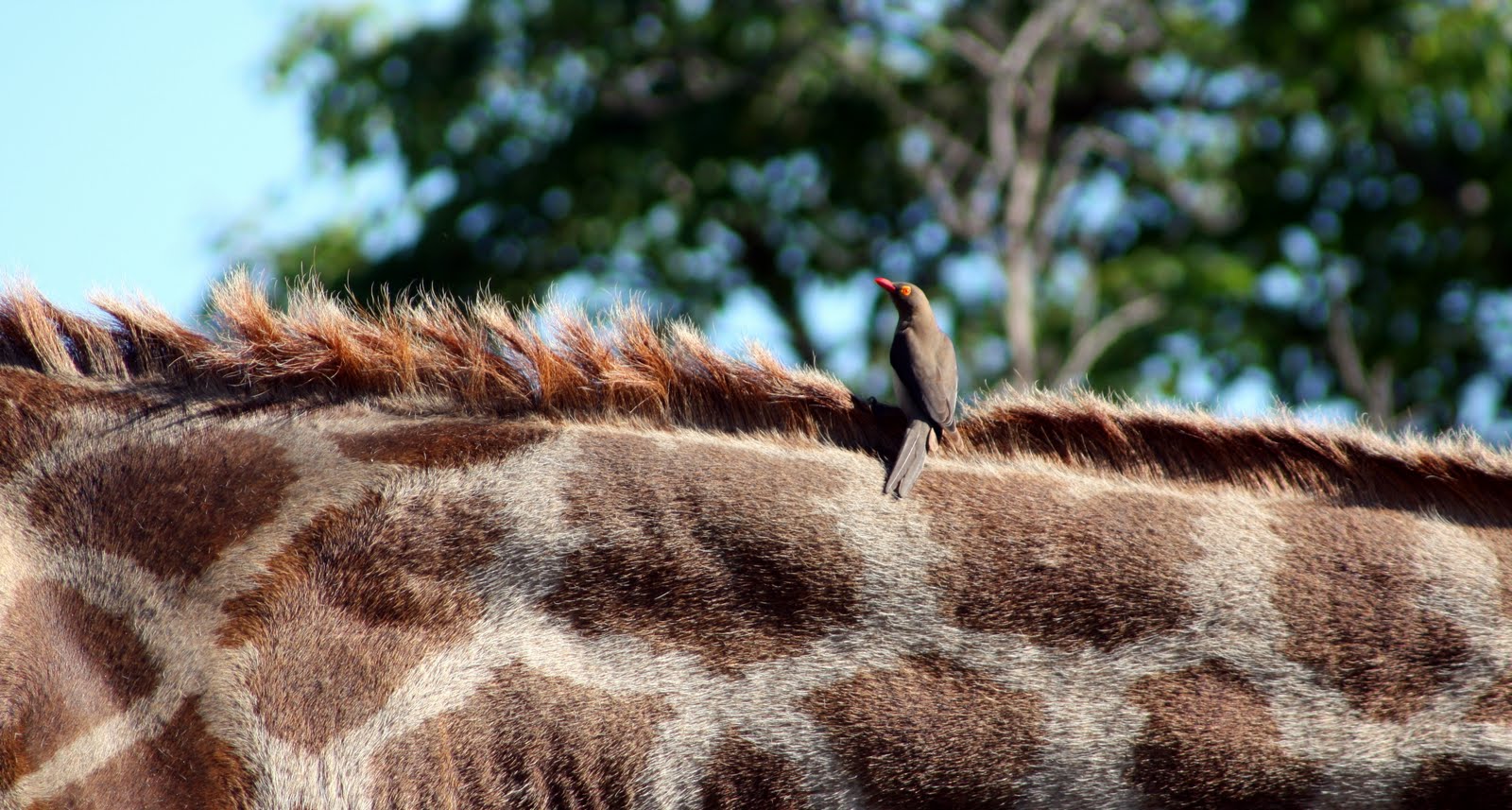
These past four days have been amazing. Now, we've done and seen some pretty cool things these past three years, but rarely have so many cool experiences happened in quick succession. On Saturday we stood in an enclosure at an endangered wild cat rescue center, not ten feet from a cheetah eating a big hunk of zebra meat. That night, as we ate our dinner at a bush camp, a family of bushbabies leaped around the branches over our heads. Early the following morning we drove into the Hluhluwe-iMfolozi Game Park and Wilderness Area where we would spend the next three days hunting the Big Five with our cameras.

Over the next few hours, from the comfort of our rental car we spotted dozens of zebra, giraffe, blue wildebeest, warthogs, baboons, impala, nyala, white rhino, and buffalo. Just before stopping for lunch, we were crossing a low bridge when we came abreast of a big bull elephant eating the leaves off a tree next to the road. We stopped to watch him and take a few pictures. We must have been too close for his comfort because he started moving towards us. Frozen by the fact that there was a huge wall of grey pachyderm with long white tusks coming towards us, ears flapping away, I completely failed to take any pictures. Sten, reacting more quickly, dropped his camera gear, got the car in gear, and swung us out around the elephant just as he stepped into the road to cross the bridge. We stopped the car a few yards away and stared at each other for a few seconds, wrapping our heads around the fact that we'd just been herded by an elephant, before Sten spun the car around to follow him down the road.

Self-driving (as opposed to going on a 4x4 tour) allowed us to do the park at our own pace. But the only way to see animals at night is to do a night drive in one of the park's vehicles. The only way to do a night drive is to stay in the park. So late that afternoon we checked into our accommodations at Mpila Camp. We would spend two nights in a permanent raised tent with an attached shower and adjoining kitchen connected by a wooden walkway. The camp is not fenced. Wild animals regularly wander through the area. As we checked in we were given a mobile number to call in case we needed any assistance during the night. The receptionist wasn't explicit about what we would need help with, but she emphasized several times that if we needed any help at all to just call and the staff would take care of "anything." A sign in our kitchen was much more forthcoming as it warned parents not to leave their children unattended lest they get carried off by a hyena. Hyena are also known to steal meat off of the braai (bbq) next to the tents. Upon returning to the marina in Richard's Bay, we would learn that last year a local man had been scalped by a leopard as he tended his braai at Mpila Camp. The bush grows quite close to the tents, and it is easy to imagine a big cat lurking in the grasses waiting for an easy meal.

After a shower and changing into long pants and sleeves, we joined 10 other people in the back of a large truck for a night drive. We'd already seen a massive amount of game that day, including three of the Big Five (buffalo, rhino, and elephant), and had hopes of seeing the remaining two (lion and leopard) during the drive. Well, we didn't see any cats, but we saw several other fierce predators, including a pack of wild dogs (we saw approximately 20 of the 500 remaining in the whole of South Africa) and a skulking spotted hyena. The other two highlights of the drive were seeing a rare black rhino (the only one we would see during our stay in the park) wading into the river to bathe at sunset and a herd of 40 or so buffalo blocking the road well after dark. By the time we returned to the camp at 7:30, we were completely wiped out from a long day of spotting game.

Kitchen on the left, sleeping tent with attached bathroom on the right...and hyenas in the bush?
Back at the camp we discovered that we (alright, I) had left the light on in the sleeping tent before we left for the drive. Unfortunately, I'd also left the door to the bathroom open. That was when I discovered that the bathroom wasn't screened in (deep eaves had obscured that fact from me before) and that we now had half of the insect population of iMfolozi inside our tent. This was a little closer than I'd wanted to get to nature. But as staying in the tent had been my idea and their presence there my fault, I couldn't very well make a fuss about it. So I turned off the light, left the bathroom door open and went to the separate kitchen to pour us each a glass of Cabernet. Meanwhile, Sten was lighting the braai in the clearing next to the tent. As he grilled a tenderloin of beef he kept his back to the kitchen and one eye on the bush around him. As we ate, we debated whether the can of mace I carry in my bag would be of any use against a hyena or wild dog. That night I woke to the sound of a hyena barking outside our tent. I eventually fell back asleep, but I must have spent the rest of the night with one eye open; when I woke the next morning the contact in my right eye was firmly glued to my eyeball.

Our second day in the park proved to be very frustrating. We were parked by a watering hole, watching a family of white rhino rolling in the mud when a second car pulled in next to us. About five minutes later we heard some very excited noises coming from the vehicle and one of the passengers turned to us and asked "Did you see it? Did you see the lion?" Apparently a lion had walked right by, but we were blocked from seeing it by their car. We spent a while longer at the watering hole waiting to see if it would pass by again, and once we got very excited when something emerged from the trees, but it turned out to be a warthog.
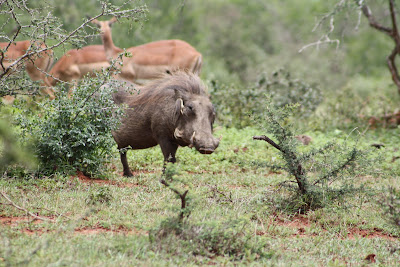
Not a lion
A few hours later, we were having an early lunch at a picnic spot when we ran into the folks who had seen the lion again. The first thing one of them said to us was "Did you see the leopard?" She went on to explain that they had just turned left out of the turnoff to the watering hole when a leopard loped across the road. Now, leopards are very rarely spotted during the day doing anything but sleeping in trees. We asked if it wasn't a cheetah. But no, she had the photo to prove that it was a leopard. So within a period of ten minutes these people had seen two of the Big Five. We had been right there and seen neither. I was so envious I might have been turning green. As she walked away I muttered under my breath to Sten "I hate these people a little bit." We packed up our stuff and headed off to continue our hunt for cats.

By mid afternoon we were starting to think that the only cat we would see was the big piece of Caterpillar machinery that was fixing one of the roads. Then at one of the river overlooks, where we were scanning the reeds hoping to see a lion, a young woman came up to us and asked if we had seen the cheetah sitting under a tree a few kilometers back. We stared at her crestfallen, wondering how we had managed to miss another cat. We must have looked devastated. She took pity on us and proceeded to give us very precise instructions on where it was. We hopped back in the car and, as instructed, turned left at the Do Not Enter sign, drove back 2.4 kilometers, and then slowed to a crawl, scanning the underbrush. There, right where she had said it would be, sat a cheetah. We were at least a hundred yards from the animal, but somehow seeing one in the wild was an even more intense experience than being in the enclosure with the cheetah at the rescue center two days prior. We sat there for ages, watching this big cat roll around, play with its tail (just like a housecat), and clean itself. Then it sensed something tasty nearby. We could see its whole body tense up. Sten rolled the car forward as we tried to follow the hunting cat, but eventually it went too deep into the trees for us to see it, even with a powerful pair of binoculars.

We spent a few more hours driving the unpaved roads in the southwest corner of the park looking for lions. There were very few other vehicles around. We were so pleased to be mostly on our own in a beautiful piece of country. We didn't see any lions, but we enjoyed seeing baby impala, which are just all legs and ears, and kudu, an antelope with spectacular spiraling horns. We also saw many of the tiny creatures including the very cool dung beetle and grass hoppers six inches long and colored like a circus clown. The park is filled with many cool and unusual birds, ranging from small colorful finches, which build upside down teardrop-shaped nests, to huge eagles and vultures. As the afternoon wore on, we saw several young male impala sparring in preparation for mating season. As we made our way back to camp for the night, the light was low and casting a beautiful golden hue across the hills. The day had been interesting, but frustrating. It was great to see the cheetah, but we were both somewhat dejected about not having spotted any cats on our own. Hot showers and a bottle of Sauvignon Blanc were on order.

Now that's a rack
That night I was woken by the sound of a wild dog crying outside our tent. A moment later a chorus of voices answered from the opposite side of the tent. I was shocked awake by the disconcerting realization that we were sleeping in the middle of a pack of wild dogs on the hunt. The dogs proceeded to call back and forth to each other as the two groups converged next to us. I was afraid to make a noise and imagined that Sten was lying there feeling the same way. Eventually they moved on and I whispered into the darkness "that was a little close for comfort." When Sten didn't respond, I realized he had slept through it. A few hours later, I could hear the pack hunting just down the hill from us. Again, Sten slept on. As I lay there in the dark I thought about the fact that there are only five thousand of these critically endangered carnivores left in the world. I felt so privileged to have shared a small slice of the wilderness with them for a night. In the morning I discovered that once again one of my eyeballs had a contact glued to it. I groggily got up to make coffee as Sleepyhead continued to burrow under his covers.

In the hide
We packed up the car and headed back to the watering hole to look for a lion. At this point we had given up on the notion of seeing a leopard and were just hoping for a lion. We saw lots of game that morning, including dozens of rhinos, but still no cats.

During our three days in the park we probably saw fifty rhino; mamas, babies and some very big bulls. These things are absolutely immense and prehistoric. As our friend George says, "add a horn to its head and few fins to its back and you've got a Triceratops." While most of the time they act like massive lawnmowers, grazing on the grasses at their feet, if they feel threatened, they will charge a vehicle. One of the yachties we know has the dents in his rental car to prove it. We were amazed by the sheer number of rhino we saw over three days. We were even more amazed when we learned that a century ago there were only 20 white rhino left in the park. But thanks to the conservationists, the park is now rife with rhino. There are now so many rhino at Hluhluwe-iMfolozi that they are regularly captured and sold to other parks and zoos around the world. By the third day of our visit to the park we were a little abashed to be finding ourselves driving by families of rhino in our quest to spot a big cat.

Just before noon on our last day in the park we were driving by a watering hole when I caught a glimpse of a distinctive profile out of the corner of my eye. I turned to Sten and, with a big grin spreading across on my face, said "go back." By my expression alone, he knew I'd seen a lion. We reversed, and there it was, 100 yards away, just sitting there, in the shade of a big tree, giving us the full Abe Lincoln. And then we both did something very stupid. Sten grabbed his camera and the monopod and climbed out to take a picture. And I, who had been holding it for way too long, got out to pee on a bush. The lion took one look at us and got up and sauntered away. Smart lion. Stupid people. So we sat there for a while, eating lunch, and hoping against hope that it would come back. But the lion was smarter than that and eventually we moved on. So our only encounter with a lion was short-lived, but it was very gratifying to spot it ourselves after many long hours of hard looking.

We had spent most of the prior two days in the southern section of the park, which is very arid, and home to more game. So we decided to exit the park at the northern gate and revisit the section we drove through on our first morning in the park. We weren't expecting much, but our last few hours in the park provided us with some incredible encounters. We saw a large group of giraffes grazing the treetops, several more rhino families, some large lizards, and a couple of elephant. Unfortunately for Sten, he was having trouble enjoying himself as I had decided that the park roads would be the perfect place for me to practice driving stick. He was paying too much attention to my driving to spot game and I was paying too much attention to the bush to stay on the left side of the road. Luckily, there weren't many other vehicles on the roads.

Giraffe - cheaper by the dozen
As the sun was setting, we were driving along a dirt track close to the park exit when we passed a 4x4 from one of the private game parks that fringe the park. The guide flagged us down and asked if we'd seen the leopard. When we said we hadn't, he gave us directions to the spot where they'd just seen one. We thanked him profusely and then I stalled the car in my excitement to get to the leopard. With an embarrassed wave to the passengers in the back of the 4x4 we took off. Even in the dim light, the leopard was easy to spot among the sparse foliage of a tall tree 400 yards off the road. I don't know that we would have seen it but I'd like to thing we would have, though probably not with me driving and Sten busy watching me driving.

We spent the rest of the evening watching the leopard. It was high in a tree, looking down on a herd of zebra grazing nearby. A leopard won't usually take a zebra, but there was a baby in the herd that it might have found tempting. We didn't get to see if anything developed as eventually we had to race to the park gate to get there before the park closed for the night. As we changed into warmer clothing for the drive home we were both bubbling with excitement. It had taken us until the last hour of our last day in the park, but we finally saw a leopard, giving us a true Big Five experience.

The Big Five are pretty awesome, but the little stuff is just as interesting

African Wildcats at Emdoneni Lodge - They may look like housecats, but don't be fooled, the cage is there for your protection, not theirs
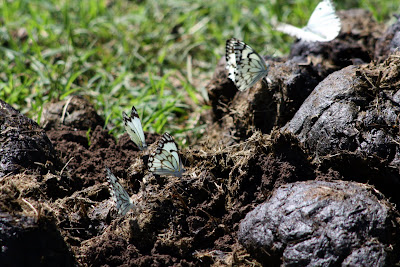
Yes, that is on odifforous pile of buffalo dung on which those butterflies are alighting. Being on safari is a feast for all the senses.
Friday, November 20, 2009
November 19, 2009 - Pressure Drop

Yet another benefit of being beamy: Not having to share a slip
Our week began with a traumatic trip to Durban for Sten (he saw dead people) and a most wonderful visit from some cruising friends who live nearby. Despite the dismal weather we've been having here, George and Colleen off of s/v Affirmation were determined to give us a proper welcome to South Africa. So in the cold and the rain they made their way up to Richard's Bay from their home outside of Durban, loaded down with bottles and bottles of luscious South African wine, a container of dukka, an aromatic North African mix of nuts and spices that they first introduced us to in Chagos, and a welcome gift bag full of other local goodies they wanted us to try, including Rooibos tea and Eet-sum-mor biscuits. No mere monsoon was going to keep these guys from a joll (party).
At some point that evening (long about our third bottle), Sten arrived back from Durbs looking completely frazzled and talking a mile a minute about bodies and engines. We poured a beer into him and took him up to Captain Cook's Restaurant (home of the Captain Burger) for a comforting plate of fish and chips. The next morning we had a very American feast of waffles with maple syrup, before sending our South African friends off to their next joll.
We've been busy the past few days doing jobs around the boat. The rigger has picked up our broken inner forestay and is making us a new one. We are eliminating the big lever quick disconnect on the forestay and adding a toggle at the bottom which should eliminate the fatigue bending that caused the failure in the first place. As an added bonus, the staysail bag will be closer to the deck when stowed.
During a brief lull in the weather, we got the headsail down (the one that failed on the way here) and found broken threads on the crosscut seams that hold several other of the panels together. Since the problem was so extensive (it would have taken me days to hand stitch it), we sent the sail down to Quantum - Durban for an evaluation and a quick repair. Depending on what they say we will look into getting a new headsail in Cape Town. Quantum's worldwide production loft is there and apparently the prices should be quite reasonable as compared to other parts of the world. So, our plan now is to hold off on the minor repairs to the main and all the canvas work we need done until we get to Cape Town where the loft is close to the boat.
Today, while I was off enjoying a spa day with the ladies off of three other boats, Sten and the boys had quite an exciting time of it in the marina. A small low developed unexpectedly and delivered 50+ knots and heavy rain for several hours. Because we aren't sitting at anchor on a mooring, we don't turn with the wind. Here in a slip, we are subject to cross breezes. During the squall, our escapist cockpit cushions were keen to take flight. After recovering several from the side deck, Sten brought them all down below, soaking wet or not.
The docks here are not too friendly with lots of metal edges and sharp corners. The wind was pushing us hard onto our fenders and it looked like several were loosing air so Sten was getting concerned as the wind kept increasing. There is no one next to us and we have a line across to the other finger pier to reduce the pressure on our fenders. This was bar tight but still not holding us off the close finger dock. During the blow, Sten managed to change this line around and get it onto the port side staysail winch and take some of the pressure off the fenders using the mechanical advantage of the winch.
While Sten was chasing cushions and trying to keep our fenders from popping, the guys tied to the dock behind us were running their engines in full reverse, trying to keep their dock and their bows from getting any closer to our stern. The whole situation was pretty sketchy. One just doesn't expect marina docks to move as much as these do.
We're not the only boat here with stays off for repair. During the blow several masts around us were doing their best impression of spaghetti. One crew member was so freaked out that she crawled over a buckled section of the dock on her hands and knees to get to shore. Meanwhile, back at the spa, we were all blissfully unaware of the drama.
Interestingly, during the blow, our wind gauge stayed in the high 30's while others saw gusts in the high 40's and even 53 knots several times. This really makes us question the velocities of some of the winds we've previously seen.
Changes in the weather come amazingly fast here. Sten commented today that watching the charting barometer is like looking at a roller coaster. Things are supposed to mellow as the summer takes hold. We're going to head off on Saturday to do some touring by car while we wait for things to settle down before we attempt to move down the coast.
Friday, September 18, 2009
September 16, 2009 - Enroute to Madagascar
This has been yet another interminable and uncomfortable Indian Ocean passage; the kind of passage that makes us wonder why we would ever want to go sailing again. Based on the extremely limited weather information available for this part of the Indian Ocean, we expected two days of light winds followed by a few of strong. Instead, after only a few hours of motoring, the wind built to 20 to 30 knots where it has stayed for the past four days. In smooth seas, or if we had been sailing off the wind, this much wind wouldn't have been terrible, but we have been sailing upwind into steep, sloppy seas. We keep scooping waves. After blowing out yet another rotten seam in the dodger, we put the third reef in the main sail. It has been there ever since. Even so, we have had to keep the jib deeply reefed in order to slow us down so that we don't take so much water on deck. That is why we are still out here. 650 miles would normally not take us longer than four days to cover at Mata'irea's regular cruising speeds of around 6.5 to 7 knots. But we've had to keep her boatspeed down to keep from causing any more damage. With the seams blown out of the windward side of the dodger, the companionway (which provides access to the living area down below) is more exposed than normal. We are keeping the companionway hatch closed, but even so we had a waterfall in the galley this morning. It is going to take us days to get our house back in order after this run. The only redeeming aspect of this whole experience is the knowledge that in such rough conditions there is no way any pirates are out here waiting for us to pass by.
To make matters worse, we were both vomitously seasick the first three days of this passage. Anything more than heating up a meal in the microwave, reheating some Campbell's soup on the stove, or brewing a cup of tea was beyond us, and even those simple acts had to be well choreographed to avoid making a total mess or burning ourselves. Sten did manage to fry some eggs one morning, but mostly we ate the meals I prepared and froze before we left. Curried pumpkin stew, pumpkin lasagna (pumpkins were one of the few cheap foods in the Seychelles), chicken tikka masala, pasta and yogurt have kept us fed and nourished.
Essential Cruising Recipe: Engine Room Yogurt
In the morning, run generator or engine long enough to charge batteries and heat up the engine room.
Put 2 cups of full cream milk powder into a clean 1 liter container (I use a Nalgene bottle).
Fill half way with 110 - 115 degree (F) water (not hotter than that - you'll kill the active agents in the yogurt).
Stir and shake to dissolve milk powder.
Add 1 cup of leftover yogurt.
Mix.
Top up with warm water.
Place in warm engine room; leave there all day.
Before going to bed, place in the fridge.

Neglected yogurt tends to behave very badly - don't forget to put it in the fridge.
My eternal gratitude to Kate on Muneera for this recipe, which works every time.
Tuesday, September 08, 2009
September 11, 2009 - Eden Island, Mahe, Seychelles
"Darling you've got to let me know,Should I stay or should I go?"
For months now the wind has been blowing strong and steady out of the southeast in the Seychelles. The market is filled with lettuce, but there aren't many fish as the fishing boats are trapped in the harbor. In Somalia, this season is bad for the swashbuckling business. On Mata'irea, we've considered it the price of doing business. Without the strong winds that blew the pirates back to Somalia, we couldn't have come to the Seychelles to meet up with family. We have paid for our pleasure with a rough passage getting here and the anticipation of a tough slog to Madagascar.

Local fishing boats waiting for the Southeast Monsoon to subside
Neither of us was excited about pounding 650 miles to windward, so we've been playing a waiting game, working on the boat, biding our time until the strong southeasterlies lessen for just a few days so that we can make a break for Madagascar, before the Northeast Monsoon sets in for good and blows the pirates back into town. While we've been cooling our heels here, we've been getting reports from friends about great shelling, fishing and wildlife encounters in Madagascar. Every day we spend here is a day less that we get to spend in Mad before making the jump to South Africa. There have been times these past few days when we almost said "screw it, let's go." But we'd spent so long waiting for a weather window that it would be foolish to go just to get out of here and then get rolled over by a low pressure system. So, we've tried to keep busy and keep from going stir crazy.
Sten has
- Changed the generator oil
- Removed, rebuilt, and reinstalled the generator raw water pump
- Had an adventure refilling a propane tank
- Repaired the watermaker
- Dragged a rolling suitcase full of 30 liters of UHT milk across Victoria
- Enviously eyed the sailfish at a fishing contest
- Spent the next day working on his fishing gear
- Rigged a third reefing line
- Expertly docked the boat at the fuel dock in a 25 knot cross breeze (proving once again that it is better to be lucky than good)
- Realized that something was wrong with the batteries
- Troubleshot said batteries and attempted to revive the $400 weak link
- Repaired the watermaker again
- Cleaned the bilge
- Got bored
- Began breaking stuff just to have something to repair

Sailfish caught (not by us) for a fishing tournament over the weekend
I've
- Cooked oodles of food for passage
- Gotten bored
- Begun cooking desserts out of boredom
- Discovered that the local rum is better as a sauce for bread pudding than for actually drinking
- Schlepped nine dozen eggs across town
- Vaselined said eggs to make them last
- Cringed as Sten broke two dozen of said eggs
- Discovered that pumpkins are a bitch to process (I could have made regular lasagna, but there hasn't been ricotta or cottage cheese available on this island for months and it would bankrupt us buy that much beef mince here)
- Washed three loads of laundry by hand (lamenting Kate's departure all the while)
- Realized that I haven't been this bored since we were waiting for a weather window to leave New Zealand

Local kids racing Opti's
It looks like we've got a window this weekend . . . and not a moment too soon. The local newspaper has reported that two Spanish fishing trawlers operating between the Seychelles and Somalia have escaped pirate attacks in the past few days. That's our signal.
"If I go there will be trouble.If I stay it will be double."
Gotta go.
Sunday, April 19, 2009
April 17, 2009 - Crossing the Bay of Bengal
 I usually update this blog daily, or at most every other day, when we are offshore. But during the first few days of our crossing of the Bay of Bengal, sitting at a computer to type was just not possible. We were bashing to windward and having to constantly shift gears to adjust our sails to deal with violent squalls and the lulls between squalls. The seas were big and messy from the combination of swell, high wind, and unpredictable currents. Then to add insult to injury, we had to tack back and run away from a developing cyclone. When things finally settled down and we were once again on the right track, albeit to a new destination, I was too exhausted to put a coherent thought together, let alone try to make it entertaining. Now, just a few days later, it is hard to recall the details or sequence of events.
The only thing I can think of is to encourage any of our readers in New England who are keen to know what an upwind passage in a sailboat in terrible conditions is like to get themselves down to Fan Pier in Boston when the Volvo Ocean Race boats arrive later this month. http://www.volvooceanraceatfanpierboston.com/port-stopover Climb aboard The Ride, a virtual reality pod that tilts and shakes and sprays mist all over the passengers to simulate the experience of beating to windward in rough seas. But here is the thing, you're going to have to ask the cute girls running the ride to leave you locked in there for at least a week. In offshore sailing, no matter how much you want to get off the ride, there is no escape hatch.

Our second night out, the folds in our double reefed main filled with rainwater and blew out the bimini
So while you are trapped in your shaking pod for days on end, getting soaked by squalls and waves, a few things are going to happen. First, you are going to need to go to the bathroom. No problem, your pod will come equipped with a toilet or two. The only trick is to get down the companionway ladder, through the galley, across the aft cabin, and into the aft head without slamming your hip or shoulders into any cabinets or doorjams as the boat accelerates off of a wave and down into a trough. Now, you've got to manage to get your shorts down far enough to sit on the toilet (even for boys standing up and peeing offshore is a very bad idea - accidentally spraying down the head will make you very unpopular with your crewmates) while the boat pitches and rolls. I recommend standing with your legs spread apart to lower your center of gravity and using one hand to hold onto the doorjam while unbuttoning with the other. Once you've got them down, sit on the head and brace your feet against the opposite wall. Sliding off the toilet mid duty is never pleasant. Once you are done, you're really only half-way there. You've still got to manage to get your shorts back up and make your way back to the cockpit, without incurring any more bruises. You will want to avoid using the head forward of the mast like the plague. If you thought the aft head was tricky, the forward one is a regular torture chamber.

During the passage I put 30 hours into restitching the bimini by hand - blowing it out turned out to be the best thing that could have happened - restitching it kept me sane - sort of.
The second thing that is going to happen is that you are going to get hungry. No problem. This is why we make passage food ahead of time. The only trick is managing to get it out of the fridge without the fridge door slamming into the cabinet front, or having the top of the fridge launch itself across the salon. Now, place your containers on top of the gimbled stove, and dish the contents out into bowls. Plates are for rookies. You can always spot the rookie - they are the ones with pasta stains on their foul weather gear. Now, you've got to get the bowl in and out of the microwave without spilling on yourself. Depending on which tack you are on, this is either a simple task or the utmost test of your reflexes. Lastly, you've got to get the food up to the cockpit, because nobody can stand being down below too long. When you are done, dump the bowls in the sink to be done the next time the sink is to leeward. Trying to wash dishes while bracing yourself against the sink with your elbows dug behind the fiddles is a fools errand. Of course, after two days on the same tack there is no more room in the sink and you are out of bowls, so someone has to be the fool - even more the fool if a freak wave happens to pour down through the companionway hatch and give her a cold salty shower while she does dishes.
Now that you've eaten, one of the crew is going to have to go off watch. Notice that I didn't say to sleep. Sleep is futile. But in order for you to be coherent enough to keep watch for ships and react to wind shifts and squalls fast enough that you don't put the boat in irons or have an accidental tack or jibe, you've got to take turns resting. Don't try to be a hero and stand watch forever. You won't be any use to anyone when the shit hits the fan, which it eventually will. So you go back to the bunk and attempt to rest while the bed drops out from under you and the piece of local hardwood that your spouse stored under one side of the mattress tries to jump up and smack you. After a few hours of that, you will get up soaked with sweat from the exertion of trying to hold yourself in one place long enough to catch a few winks. The bed will also be soaked. This is why the crafty crew member will always volunteer first to be off watch. Much better to lie in your own sweat rather than someone else's, even if the other person is the love of your life.
Sten, tell us how you really feel about upwind passages
By day three you'll be trying to figure out how this fatalistic person who keeps talking about how you might not ever get to your destination and might need to turn back and spend another season in Asia ever became the love of your life. You will be wondering where you took the wrong turn that led you to find yourself in a boat, in the middle of the Bay of Bengal with Eeyore. But then Eeyore makes roast chicken with garlic and vegetables flavored with white wine and thyme in large pot on top of the stove for Easter Dinner and you find yourself wondering what you would ever do without him. And with one bite of that delicious dinner, all is right with your world. Despite the sleep deprivation. Despite the rail rash (a fancy yachtie term for diaper rash) from sitting in a wet cockpit for days on end. Despite the need to pop another Stugeron every time another squall hits and within seconds accelerates the wind from 15 knots to 40 knots and veers 100 degrees. Despite the lightening that flashes around you so frequently that you are anxious enough about getting hit to store your handheld VHF radio, GPS and Satphone in your Faraday Cage (aka, the microwave). Despite the fact that trying to head southwest across the Indian Ocean at the beginning of the Southwest Monsoon is perhaps the stupidest thing you've ever done together. Despite the fact that you can't head anywhere near southwest because the sea is so rough that your boat will only go perpendicular to or away from the wind. Despite the fact that cyclone season is just around the corner. Despite the fact that the low pressure system to your north is deepening into the danger zone. Despite all that, you can not help but love a guy who will make you comfort food in a storm. You even offer to let him have the first off watch in the still dry bunk.

40 knots, on the way
Day four brings the frustrating realization that the seas have become so big that you can't possibly make progress to the southwest, even with the assistance of the engine. You have three options. You could turn tail and run back to the Andamans to try to convince Immigration to let you back in to wait for a better weather window. You could turn west northwest, which would keep you moving somewhat towards your destination, but it could lead you to be trapped in the northwest corner of the Bay of Bengal, an area that in the months ahead will be swept by numerous cyclones. It is still early for cyclones this year, but the conditions are becoming more favorable each day. Or, you could run east southeast, adding miles and miles to an already long passage. A horrifying, yet beautiful sunset tilts the scales. As you look a sky filled with too many different types of clouds to try to identify them all, you make the decision to run for it.

The morning of day five brings affirmation from the U.S. Navy's weather forecasting service of your decision to run. A tropical depression and area of convection is developing just to the north where you turned around the the night before. You are relieved to have made the right decision, but concerned about the potential for a cyclone to develop. For the rest of the day and night you run east southeast, away from the developing storm, but unfortunately also away from the Maldives. Meanwhile the Navy upgrades the potential for the the development of a cyclone from poor, to fair, and eventually to good. But you are now hundreds of miles away from the developing storm, and feel that it is safe enough to turn west. Your destination is no longer the Maldives. You've decided to motorsail your way out of this mess, and hopefully reach Sri Lanka before you run out of diesel.

By the afternoon of your sixth day at sea, the tropical depression has become a named storm, Cyclone Bijli, but it is now 450 miles away and tracking north. Meanwhile, you've recovered enough to venture forward of the mast to see what a week of pounding has done to the fresh food stores in the v-berth. Just as you feared - your carefully selected and stowed tomatoes have become tomato sauce that has oozed all over the mattress. And what's that smell? Oh nice, rotting cucumbers. Your spouse can see that this is the last straw and volunteers to help you pick through the mess to sort out the salvageable produce. He spends the afternoon squeezing dozens of fresh limes before they rot.
On the seventh day, the weather is improving and you are making progress towards your new goal of Sri Lanka. You should be excited about a new and unexpected destination, but instead you've got a case of the mean reds. You've had it with this godforsaken boat and being wet and having rail rash and trying to move without getting bruised and sleep without battling for every wink. You want off. You're miserable and you don't care who else has to put up with it. It becomes Eeyore's turn to play Tigger and try to cheer you up. He tries to bribe you with candy and an offer to change the sheets when you get to port, but nothing is working. And then you rediscover baby powder. Since you haven't actually used the stuff since, well, since your mom was regularly patting you down with it before pinning up your diaper, you have no idea what a bottle of it is doing on the boat, but, ah, what a difference it makes. Once your bum is more comfortable, somehow everything seems a little brighter and more manageable. You are still trapped on a boat in the Bay of Bengal during cyclone season, but at least you can sit comfortably while you keep track of the ships in the shipping lane just to the south.
Unfortunately, even after a week in your simulation pod you still really won't know what it is like to do a truly miserable upwind offshore passage. That's because you won't get to experience the euphoria of digging your anchor into a new harbor at the end of the passage and the excitement of exploring a new country. The intensity of those pleasurable feelings is only heightened by the struggle you go through to get there. Arriving someplace by airplane never feels as satisfying as getting there on your own boat. And after a week in the pod, the cute girls running The Ride will not be at all impressed with you or what you've done to their pod. So you'd better just go on it once, then head over to the Dome to check out some sick race footage, before making your way over to play with the remote control boats. And if you can, sign up for the pontoon tours to check out the living conditions on board an offshore racing machine. Compared to the guys on the Volvo boats, we're traveling in the height of luxury. We have a door on our head and everything.
Sunday, April 05, 2009
April 1, 2009 - Little Andaman, Andamans, India
Things have been going so well lately that we were clearly due for some suckage. We headed south from Rutland Island to Little Andaman in search of surf. However, not only was Sandy Point not working while we were there, but the wind always seemed to be against us. We ended up spending three days listening to the engine burn our cash into fumes as we pounded into wind-generated chop, just so that Sten could have the privilege of getting attacked by flying ants as he tried to cook dinner and I could experience the feeling of sheer horror when realizing that I'd just dropped our anchor and fifty feet of chain into a field of tsunami debris (in my defense, it was twilight, and Hut Bay Port Control had radioed and asked us to move to that location to make way for a passenger ferry; I didn't see the shadowy grid of the old pier below the surface of the water until the anchor was well and truly stuck within a maze of concrete and steel). The only good thing I have to say about our Little Andaman experience is how very well we worked together in a very bad situation. Our communication skills have come a long way in the two and half years that we've been out cruising.
----------
radio email processed by SailMail
for information see: http://www.sailmail.com
Saturday, November 22, 2008
November 21, 2008 - Sweet Home Chicago
Our trip back to the States got off to a fairly rocky start when Sten, wearing an old pair of shoes with no tread on them and carrying a 50lb piece of luggage, stepped off the boat in the pre-dawn dark, onto a wet dock, and slipped and fell, whacking his head on Mata'irea's stainless steal rub rail. We checked for blood, and since the wound was only slightly sticky and Sten could still tell me who the President was, we headed for the airport, rather than the hospital. And we decided that our first order of business in Chicago was to get the boy a new pair of shoes.
Singapore's airport consistently wins awards for being the best airport in the world. It is spacious and clean. The lines move quickly. The trams come immediately (we happen to know this because Sten and I are completely incapable of starting a long trip in the correct terminal). They provide free internet terminals throughout the airport, some of which are stationed right at the gates. If you have a long layover there, you can go watch a free movie or check into a transit hotel to catch some shuteye. It is easily the nicest airport we've ever been in.
Our layover in Tokyo was a let down after Singapore, but we were entertained by the Japanese cultural experiences offered to travelers. You could sit down with a little old lady and learn how to do origami, or join a slightly younger woman for a traditional tea ceremony. We were also entertained by the bizarre foods available at the duty free shops.
 Who's up for a green tea Kit Kat?
But the most entertaining thing was looking out the windows of the terminal and seeing the sun setting at 4:15. The last time we saw the sun set before 6pm was when we were home for the holidays (back in the high latitudes) last year. In the tropics, there is no long sunset or sunrise. The sun drops out of the sky like a coconut falling from a tree at the same time every day. In the morning, it rockets back out of the sea. Only poets living in the high latitudes would write verses about Dawn's rosy fingers traipsing across the sky.
 We flew through the night, and arrived at Chicago O'Hare in the middle of the afternoon, 20 some hours after leaving the boat. We were picked up at the airport by our good friends, Kate and PJ, and taken back to their house to hang out for a few hours while snow fell outside, before meeting up with some more friends for 'ritas and burgers. When we got to Deb and Mike's house, they showed us to our room for the weekend and handed us a cell phone to use while we are town. I can confidently say, we have the best group of friends in the whole world. It is good to be home.
When we planned our trip home this year, we decided to stop in Chicago for a few days on the way to my parent's house for Thanksgiving, rather than visiting our friends here over New Years, as we've done the past few years. The reasoning was two fold:
 After hitting Nordstrom's to buy Sten some shoes that will not cause him bodily harm, we battled our way through the freezing blast of Chicago's winter wind to get to Topolobampo. The temperature display on one building we passed read 25 degrees. Our faces and lungs hurt from the cold air and we realized how soft we'd gotten in two years in the tropics. But our first bite of guacamole made it all worth it.
Halfway through lunch my jetlag caught up with me (I'd been up since 3am) and by the time we got back to Deb and Mike's it was all I could do to shrug off my coat before falling into bed. Sten sacked out on the couch until Deb and Mike made it home from work. Later on, Kate and PJ, Rob and Jodi, and the infamous Sid all came over for some beer and pizza, Euchre (it is statistically impossible to have 3 or more Ohioans in a room and not play Euchre) and Xbox Rock Band.
 Xbox Rock Band - the most fun I've ever had sober. Oh wait, I wasn't sober.
Singapore's airport consistently wins awards for being the best airport in the world. It is spacious and clean. The lines move quickly. The trams come immediately (we happen to know this because Sten and I are completely incapable of starting a long trip in the correct terminal). They provide free internet terminals throughout the airport, some of which are stationed right at the gates. If you have a long layover there, you can go watch a free movie or check into a transit hotel to catch some shuteye. It is easily the nicest airport we've ever been in.
Our layover in Tokyo was a let down after Singapore, but we were entertained by the Japanese cultural experiences offered to travelers. You could sit down with a little old lady and learn how to do origami, or join a slightly younger woman for a traditional tea ceremony. We were also entertained by the bizarre foods available at the duty free shops.
 Who's up for a green tea Kit Kat?
 We flew through the night, and arrived at Chicago O'Hare in the middle of the afternoon, 20 some hours after leaving the boat. We were picked up at the airport by our good friends, Kate and PJ, and taken back to their house to hang out for a few hours while snow fell outside, before meeting up with some more friends for 'ritas and burgers. When we got to Deb and Mike's house, they showed us to our room for the weekend and handed us a cell phone to use while we are town. I can confidently say, we have the best group of friends in the whole world. It is good to be home.
When we planned our trip home this year, we decided to stop in Chicago for a few days on the way to my parent's house for Thanksgiving, rather than visiting our friends here over New Years, as we've done the past few years. The reasoning was two fold:
- If we want to spend some time cruising Malaysia and Thailand in January before pushing on to the Andamans in February, we need to get back to Singapore earlier rather than later, so we're flying back on New Years.
- We were really jonesing for some of Rick Bayless's Mexican cooking. Every time we've come to Chicago for New Years, Rick's restaurants are closed for their seasonal holiday. So by showing up in November, we actually get a chance to eat in our favorite restaurant.
In the summer of 1997 we decided to move to Chicago over margaritas at the bar at Frontera Grill. Our love affair with this fantastic city and Mexican food began that night. It has been years since we've been to chef Rick Bayless's fancier joint, Topolobampo, which happens to be one of the Obama's favorite restaurants (click here for a mouthwatering audio slideshow of Rick Bayless preparing one of our favorite dishes; there are rumors circulating that Rick is going to be tapped as the new White House chef, but he is denying them), so we decided to make some reservations for our first afternoon back in town.
 After hitting Nordstrom's to buy Sten some shoes that will not cause him bodily harm, we battled our way through the freezing blast of Chicago's winter wind to get to Topolobampo. The temperature display on one building we passed read 25 degrees. Our faces and lungs hurt from the cold air and we realized how soft we'd gotten in two years in the tropics. But our first bite of guacamole made it all worth it.
Halfway through lunch my jetlag caught up with me (I'd been up since 3am) and by the time we got back to Deb and Mike's it was all I could do to shrug off my coat before falling into bed. Sten sacked out on the couch until Deb and Mike made it home from work. Later on, Kate and PJ, Rob and Jodi, and the infamous Sid all came over for some beer and pizza, Euchre (it is statistically impossible to have 3 or more Ohioans in a room and not play Euchre) and Xbox Rock Band.
 Xbox Rock Band - the most fun I've ever had sober. Oh wait, I wasn't sober.
At 2:30am we decided that we were so good that it would be a shame to keep our talent to ourselves. We headed to the local karaoke bar, only to find it shut. Then we grabbed some cabs to the next joint, only to find it closed as well. As Kate said, "I haven't been this young in years." At that point we decided to take the hint and call it a night as we had plans to reconvene at a bar in a few hours for the Ohio State - Michigan Game.
Subscribe to:
Posts (Atom)


